SEO Strategies for AI
If you’ve been following SEO over the last year, you’ve probably noticed that the conversation has changed.
We’re no longer talking only about getting your website onto page one of Google.
People are asking questions directly to ChatGPT. They’re using Perplexity to research businesses and products. Claude can search the web. Microsoft Copilot uses web search to bring current information into its answers.
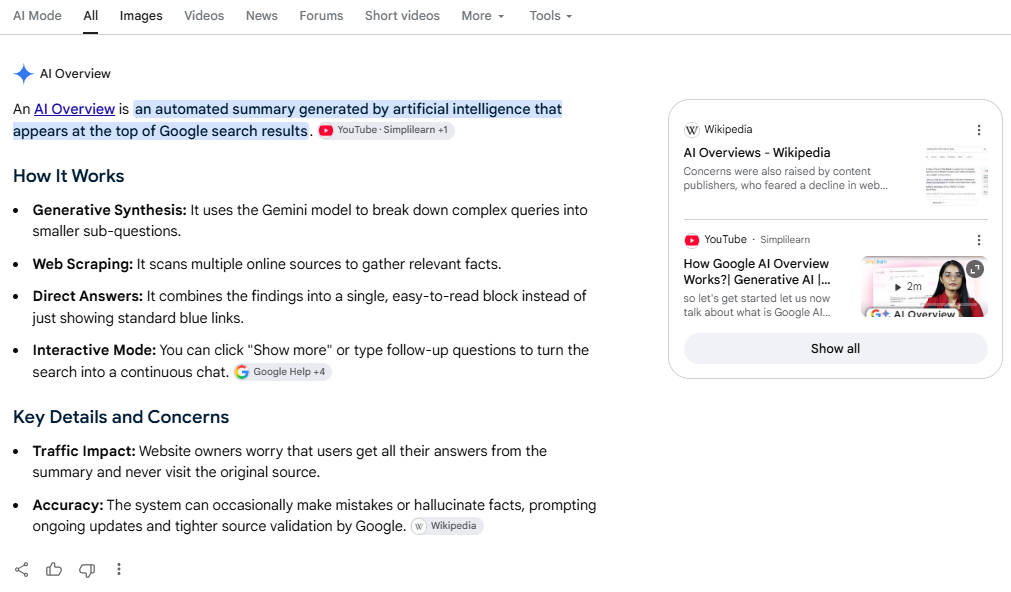
And Google itself now has AI Overviews and AI Mode.
So naturally, the next question is:
Does my website need to be optimised for AI?
The short answer is yes, but probably not in the way some of the newer “AI SEO” packages would have you believe.
You don’t need to create five different versions of your website.
You don’t need to rewrite every page specifically for ChatGPT.
And you don’t necessarily need a collection of mysterious AI files sitting next to your sitemap.
What you do need is a website that is technically accessible, understandable and useful to the search and AI systems that may need to discover and retrieve its information.
And that’s where things get interesting.
SEO is no longer just about one search engine
For years, when I talked to a client about SEO, the conversation was fairly straightforward:
Google → crawl → index → rank → click.
Bing was there too, of course, but for most businesses Google was the main focus.
AI has added more layers to that process.
A potential customer might now:
- Search Google and receive an AI-generated overview.
- Ask ChatGPT to recommend local businesses.
- Use Perplexity to research a product or service.
- Ask Claude a question that requires current web information.
- Use Microsoft Copilot, which can use Bing to retrieve information from the web.
These systems don’t all work in exactly the same way. Go and read why they aren’t the same.
They use different models, retrieval systems, crawlers, indexes and tools.
That’s why I don’t think the future is about creating a completely separate “AI SEO strategy” for every platform.
The smarter approach is to build a strong website foundation and then make sure the relevant systems can actually access it.
The first step isn’t content. It’s access.
This is probably the least exciting part of AI optimisation.
Which is exactly why it gets overlooked.
Before worrying about whether ChatGPT might mention your business, you need to ask a much more basic question:
Can the systems that need to discover your website actually crawl it?
Google has its crawlers.
Bing has Bingbot.
OpenAI uses OAI-SearchBot for ChatGPT Search.
Perplexity has PerplexityBot.
Anthropic documents several crawlers, including Claude-SearchBot for search-related purposes.
These aren’t theoretical.
They’re actual mechanisms used to discover and retrieve web content.
OpenAI specifically tells publishers that if they want their content to be included in ChatGPT Search summaries and citations, they should make sure they aren’t blocking OAI-SearchBot.
Perplexity similarly documents its crawler and how it interacts with robots.txt.
Anthropic provides its own crawler guidance, including separate controls for ClaudeBot, Claude-User and Claude-SearchBot.
So one of the first things I’d check on a website is remarkably simple:
What does the website’s robots.txt actually allow?
Your robots.txt may be more important than you think
The robots.txt file is one of those files most website owners will never see.
It’s just sitting there quietly at the root of the website.
But it tells crawlers which parts of your site they are allowed to access.
A correctly configured robots.txt file can allow legitimate search and discovery crawlers to access your public website while keeping areas that shouldn’t be crawled out of their way.
A badly configured one can do the opposite.
And this isn’t only about Google.
OpenAI explicitly says its crawlers respect robots.txt rules and recommends checking crawler access as part of making websites accessible to ChatGPT. It also points out that websites can have additional layers of protection—such as WAFs, CDNs, bot mitigation, CAPTCHAs and authentication—that can prevent legitimate crawlers from reaching the site even when robots.txt appears correct.
That’s an important distinction.
“The robots.txt file allows the bot” does not necessarily mean “the bot can access the website.”
But do you need to optimise separately for ChatGPT, Claude, Perplexity and Copilot?
This is where I’d push back against some of the AI SEO noise.
I don’t think most businesses need:
Google SEO strategy
- ChatGPT SEO strategy
- Claude SEO strategy
- Perplexity SEO strategy
- Copilot SEO strategy
That quickly becomes an expensive mess.
Instead, think of your website as having a common foundation.
The foundation includes things like:
- Crawlability
- Indexation
- Internal linking
- Useful content
- Clear information architecture
- Technical SEO
- Page performance
- Structured data where appropriate
- Accurate business information
- Genuine expertise and experience
- Local signals where relevant
Those things benefit the website regardless of which system ultimately discovers it.
Then there are platform-specific considerations.
That’s where the technical optimisation comes in.
Google and Bing are still part of the picture
This doesn’t mean traditional SEO has suddenly become irrelevant.
Quite the opposite.
Google’s current guidance for its generative AI Search features says existing SEO fundamentals continue to matter. Google also says pages need to be indexed and eligible to appear in normal Search in order to be eligible as supporting links in its AI Search experiences.
And Bing remains important for Microsoft’s search ecosystem.
Microsoft explains that Bingbot crawls the web, builds the Bing index and provides the underlying search results used by Bing.
Microsoft’s Copilot documentation also explains that when web search is enabled, Copilot generates a query and sends it to Bing, using the resulting web information to improve its answer.
So if you’ve already set up:
Google Search Console
and
Bing Webmaster Tools
that’s a very good start.
You don’t need to throw that work away and start again because AI has arrived.
Then there are the AI-specific access layers
This is where things get more interesting.
OpenAI tells website owners that allowing OAI-SearchBot can help their content be discovered, surfaced and cited in ChatGPT Search.
Perplexity has its own crawler.
Anthropic has multiple documented crawlers with different purposes, including one specifically associated with search.
And Microsoft largely brings us back to Bing.
So rather than asking:
“How do I optimise my website for AI?”
I’d ask:
“Which systems do I want to be able to discover my website, and can they actually access it?”
That’s a much more useful question.
And then we get to the content
Once access is sorted, we can talk about what these systems actually find.
And here, the advice becomes surprisingly familiar.
Google’s May 2026 guidance specifically emphasises useful, non-commodity content and continues to recommend established SEO fundamentals rather than requiring a separate technical layer for AI Search.
In practical terms, that means content that demonstrates something real.
A case study is more useful than another generic article explaining what a case study is.
A local business explaining how it solved a customer’s specific problem is more useful than a page stuffed with twenty variations of “best service provider near me.”
A photographer’s actual portfolio tells me more than a paragraph claiming they’re “passionate about photography.”
A web designer showing the reasoning behind a project provides something that a generic AI-generated article about web design can’t.
This is where smaller businesses have an advantage.
You have experience that AI doesn’t.
Use it.
Your website needs to make sense
There’s another part of AI optimisation that isn’t particularly glamorous but matters enormously:
information architecture.
Can a person—or a search system—work out:
- What your business does?
- Where you operate?
- What products or services you provide?
- Who those products or services are for?
- What makes you different?
- How your services relate to one another?
- Who is behind the business?
- How to contact or buy from you?
If those answers are scattered across twelve pages, buried inside sliders and hidden behind clever animations, you’ve created a website that looks good but makes information unnecessarily difficult to retrieve.
Good website architecture helps humans.
It also gives machines a much clearer picture of what the business actually is.
What about Schema?
Structured data still has a place.
But I wouldn’t describe it as “AI schema.”
Google’s current guidance specifically says there isn’t special structured data required for its generative AI features. At the same time, structured data remains relevant to supported Search features and can help Google understand page content.
So the approach I’d take is:
Use appropriate structured data because it has a legitimate Search purpose—not because someone has invented a special AI markup package.
For example, depending on the website, that could include structured data relating to:
- Products
- Local businesses
- Organisations
- Articles
- Breadcrumbs
- Events
- Reviews
- Other supported Search features
The important word is appropriate.
More schema isn’t automatically better schema.
And no, you probably don’t need an llms.txt file
This has become one of my favourite examples of how quickly an emerging technical idea can turn into a product.
Google’s current guidance is unusually clear: llms.txt isn’t needed for Google Search, and maintaining one won’t positively or negatively affect visibility or rankings there. Google does say it can be maintained for other services or systems that actually use it.
That’s an important distinction.
I’m not saying:
“llms.txt is useless.”
I’m saying:
“Don’t pay for llms.txt because someone told you Google requires it for AI Search.”
If a particular AI system, documentation platform or technical application actually supports it, that’s a different discussion.
The technology needs a reason to exist.
I’m still in favour of using one.
The same principle applies to AI visibility scores
Another thing I’d be cautious about is the growing number of platforms offering AI visibility scores.
You might be shown something like:
AI Visibility: 68%
or:
Your brand is mentioned in 14% of AI responses.
Those numbers can be useful within the methodology of the particular tool.
But they aren’t necessarily measurements supplied by the AI platform itself.
Google has specifically warned that third-party SEO tools don’t have access to its internal ranking data and can’t guarantee performance. Predictions made by those tools are their own predictions.
So I wouldn’t throw all third-party tools out.
I’d simply ask:
What exactly is this number measuring?
And:
Who actually generated the data?
That’s a much healthier way to approach AI SEO.
What does AI optimisation actually look like?
It isn’t one plugin.
It isn’t one file.
It isn’t connecting your website to an AI.
And it certainly isn’t a button labelled:
“Optimise for AI.”
It’s a combination of technical accessibility, content quality, information architecture, structured data, search visibility and business credibility.
Some of the work is visible.
A lot of it isn’t.
And some of it is quite technical.
That’s where a proper website optimisation process becomes useful.
Where I’d start with a business website
I wouldn’t start by rewriting every page.
I’d start with an audit.
I’d look at the technical foundation first.
Then I’d examine how the website is structured and whether important information is accessible.
Then I’d look at how search engines and relevant AI crawlers can discover the site.
Then I’d look at the content itself.
And only after that would I start deciding what actually needs to change.
The goal isn’t to make a website “AI-friendly” by adding as many AI-related things as possible.
The goal is to make the website discoverable, understandable and useful.
That’s a much more sensible long-term strategy.
Is your website ready for AI search?
This is becoming another question I ask when reviewing a website.
Not:
“Have you bought GEO?”
But:
“Can the systems that matter actually find, access and understand your website?”
There are several technical layers involved, and the answer isn’t always obvious from looking at the website itself.
A site can look perfectly normal in Chrome while:
- important pages are blocked from crawling,
- an AI crawler is being denied,
- a security layer is returning a 403,
- important content depends too heavily on JavaScript,
- indexing directives are inconsistent,
- structured data is missing or incorrect,
- or the site’s information architecture makes key business information difficult to understand.
That’s the sort of work I can help with.
AI website optimisation with SwanDesign
At SwanDesign, I’m approaching AI optimisation as an extension of good technical SEO and website development—not as a completely separate marketing gimmick.
The starting point is making sure your website’s technical foundation is correctly configured for modern search and AI discovery.
That includes reviewing things such as robots.txt and crawler access, followed by the other technical and content signals that help search and AI systems discover and understand your business.
You don’t need to hand your website over to a mysterious “AI SEO machine.”
You need someone to look at the actual website, understand how it is built, identify what is preventing it from being properly discovered or understood, and fix the things that genuinely need fixing.
If you’d like your website reviewed for AI-search readiness, get in touch with SwanDesign.
We’ll start with the fundamentals, including a properly configured robots.txt file and work from there.