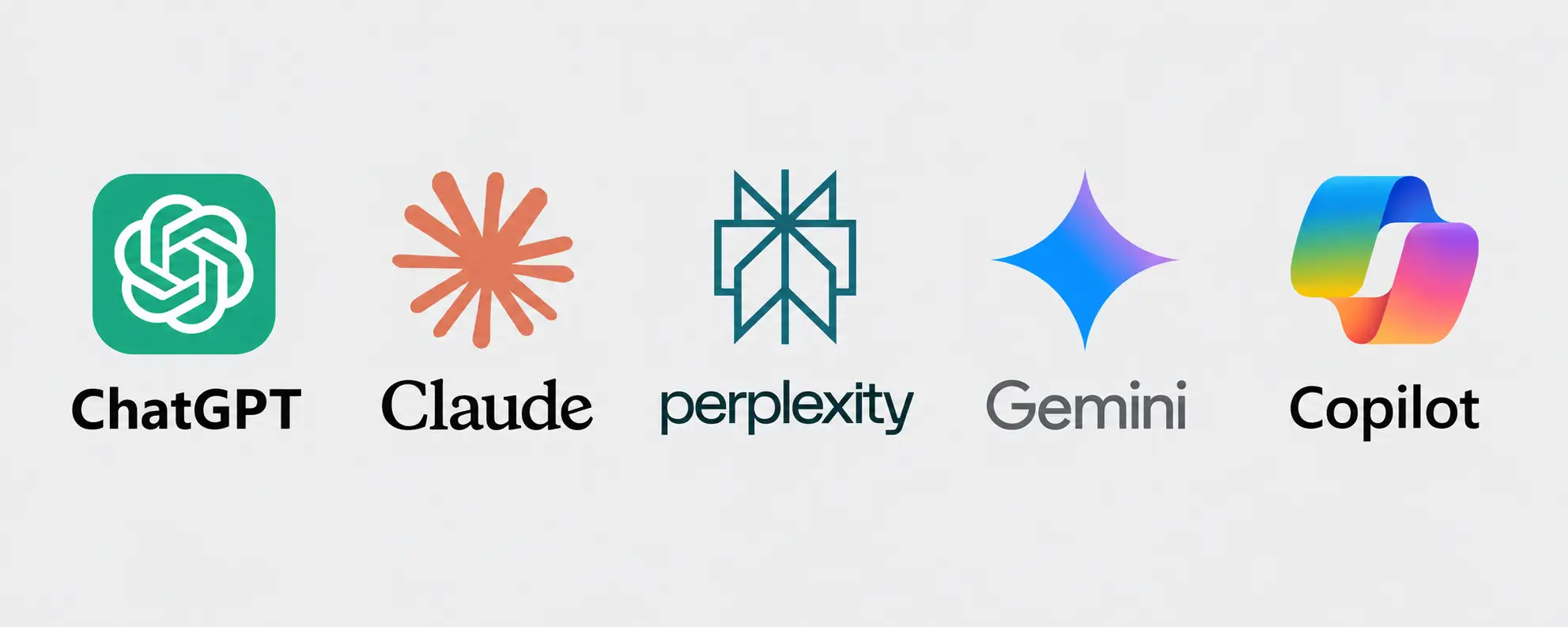
Why ChatGPT, Claude, Perplexity and Copilot aren’t the same thing
People often talk about “AI search” as though there’s one giant AI search engine.
There isn’t.
The products can differ across at least five layers:
Model → retrieval system → index → tools → sources
And those differences matter.
Here’s the simplified picture.
| Platform | Models | Web/retrieval | Index / sources | Important distinction |
|---|---|---|---|---|
| ChatGPT | OpenAI GPT models, with model availability changing over time | Web search, browsing and other tools depending on product/mode | Web sources retrieved for the query; other connected sources/tools depending on context | OpenAI controls both the model and its search/tool layer |
| Claude | Anthropic Claude models | Claude web search + other tools | Web results retrieved during search; user/project knowledge can also be used | Claude can perform multi-source web search and cite sources |
| Perplexity | Multiple frontier models | Proprietary search/retrieval system | Its own search infrastructure plus third-party crawling/indexing arrangements | Particularly search-centric and explicitly model-agnostic |
| Microsoft Copilot | Microsoft/OpenAI models plus other model options in some experiences | Bing web search + Microsoft grounding | Bing index + Microsoft Graph/organisation data depending on product | Strong integration with Microsoft’s search and productivity ecosystem |
| Google Gemini / AI Mode | Google’s Gemini family | Google Search retrieval systems | Google Search index + Google’s other information systems | Most tightly integrated with Google’s own Search ecosystem |
There is an important caveat: these architectures are not static. Providers change models, routing, search infrastructure and available tools frequently.
So I’d treat the table as a conceptual map rather than a permanent technical specification.
With reference to my 2026 AI & SEO article regarding llms.txt files and their usefulness, let’s unpack it.
ChatGPT
ChatGPT is not simply:
GPT → internet
OpenAI’s search experience can decide when web search is useful, retrieve relevant web information and provide citations/links. OpenAI describes ChatGPT Search as combining a natural-language interface with timely web information.
OpenAI also has increasingly agentic browsing/tool capabilities. Its current product direction includes a built-in browser capable of gathering information online and using web-based tools.
For a website owner, one of the most concrete things we can control is crawler access.
OpenAI currently identifies OAI-SearchBot as the crawler used to discover content for ChatGPT search, and its publisher guidance says websites should avoid blocking it if they want their content available for inclusion in ChatGPT search summaries and citations.
Claude
Claude is different again.
Anthropic’s current web-search capability allows Claude to search the internet and return cited sources. Anthropic says Claude processes multiple sources when searching the web.
Claude also has retrieval capabilities that go beyond public web search.
For example, Claude Projects can use retrieval-augmented generation to access much larger bodies of project knowledge. Anthropic says its RAG system can expand the amount of project knowledge Claude can work with substantially.
Anthropic has also published technical material about contextual retrieval, combining semantic retrieval with techniques such as BM25 indexing to improve retrieval accuracy.
So when someone says:
“How do I optimise my website for Claude?”
that’s already an underspecified question.
Do you mean:
- Claude’s public web search?
- Claude reading a URL?
- Claude Projects?
- An Anthropic API implementation?
- A company building a RAG system using Claude?
Those are different retrieval environments.
Perplexity
Perplexity is probably the easiest one to understand as a search-first AI product.
Perplexity describes itself as an answer engine that researches the open web in real time and returns cited answers. It also says it routes queries across multiple frontier models.
This is particularly interesting because Perplexity doesn’t rely on one permanently fixed model.
Its infrastructure can combine:
search + retrieval + model selection + synthesis.
Perplexity’s 2026 updates even describe Model Council, where multiple models—including GPT, Claude and Gemini models—can be run in parallel and their outputs synthesised.
That’s a perfect demonstration of why “optimise for the AI model” can be the wrong abstraction.
The model producing the final answer might not even belong to the company running the search product.
And Perplexity has its own crawler
Perplexity documents PerplexityBot, which is designed to surface and link websites in Perplexity search results. It explicitly recommends allowing the crawler through robots.txt if you want your site to appear in its search results.
That’s another reason I’m increasingly interested in crawlability and access controls rather than invented AI markup.
Microsoft Copilot
Copilot is particularly complicated because “Copilot” isn’t one single product architecture.
Microsoft has Copilot experiences integrated into consumer products, Microsoft 365, Windows and enterprise environments.
For Microsoft 365 Copilot Chat, Microsoft says web mode is grounded in the public web through the Bing search index.
Microsoft also explains that when Copilot performs web search, users can inspect the query it sent to Bing and the sources it used.
But Microsoft 365 Copilot can also work with organisational information.
Its Researcher agent, for example, can gather and analyse information from the web and work documents, emails, meetings and chats to which the user has access.
That’s a radically different retrieval environment from public Google Search.
For an ordinary business website, the public-web side is the relevant part.
For an enterprise, however, Microsoft Graph and internal organisational data can become hugely important.
Google Gemini / Google AI Search
Google is the odd one out in this particular comparison because Google controls the entire traditional Search ecosystem underneath its AI Search experience.
Google’s current documentation explains that AI Overviews and AI Mode use its Search index and retrieval systems, including RAG and query fan-out. The system can generate additional related queries, retrieve information and then construct a response from those results.
So just to be clear: Google’s advice applies to Google’s AI Search.
It shouldn’t automatically be extrapolated to ChatGPT, Claude, Perplexity or every future AI agent.
The important SEO lesson
And this is where I think this gets really interesting.
Instead of thinking:
“How do I optimise this website for AI?”
I’d start thinking:
“Which discovery systems do I actually want this website to be accessible to?”
Then there are some very concrete technical questions.
- Can Google crawl it?
- Can Google index it?
- Is it eligible for Search?
- Is the structured data accurate?
- Is the Business Profile maintained?
- Is Merchant Center maintained where relevant?
ChatGPT
- Is OAI-SearchBot allowed to crawl the relevant content?
Perplexity
- Is PerplexityBot allowed to crawl the content?
Claude
- Can Anthropic’s web search access and retrieve the content when relevant?
Copilot
- Is the content discoverable through Bing?
- For enterprise environments, is the information available through the appropriate Microsoft-connected systems?
So where does this leave llms.txt?
I’d put it into three buckets:
Google Search
Don’t need it.
Google says it ignores it for Search.
Other AI/search systems
Potentially useful, but only where the system actually supports it.
Perplexity’s own documentation, for example, uses llms.txt for documentation discovery.
Your own AI infrastructure
Potentially useful as an information-architecture mechanism.
If you’re deliberately creating an AI-readable documentation layer for an agent, RAG system or other application, that’s an engineering decision rather than Google SEO.
And that distinction is exactly how I’d explain it to a client.
Takeaway
Don’t confuse “AI optimisation” with “Google optimisation”
Google’s May 2026 guidance is specifically about Google Search’s generative AI features. It doesn’t establish universal rules for ChatGPT, Claude, Perplexity, Copilot or private AI agents.
Different AI products can use different models, search engines, indexes, crawlers, retrieval systems and tools. A recommendation that doesn’t help Google Search may still have a legitimate use elsewhere but the vendor should be able to explain which system it is for and why.
In other words, before paying for an AI optimisation tactic, ask one very simple question:
“Which AI system actually uses this?”
I think that question is going to become increasingly useful over the next couple of years.
And frankly, it might save a few businesses from buying some beautifully branded snake oil.
One factual refinement I would make to the previous discussion: Anthropic currently documents ClaudeBot, Claude-User and Claude-SearchBot, with Claude-SearchBot specifically used to improve search-result quality. Microsoft Copilot’s web search, meanwhile, sends queries to Bing, so Bingbot/Bing indexing remains the important underlying layer rather than a separate “Copilot bot.”
Sources: