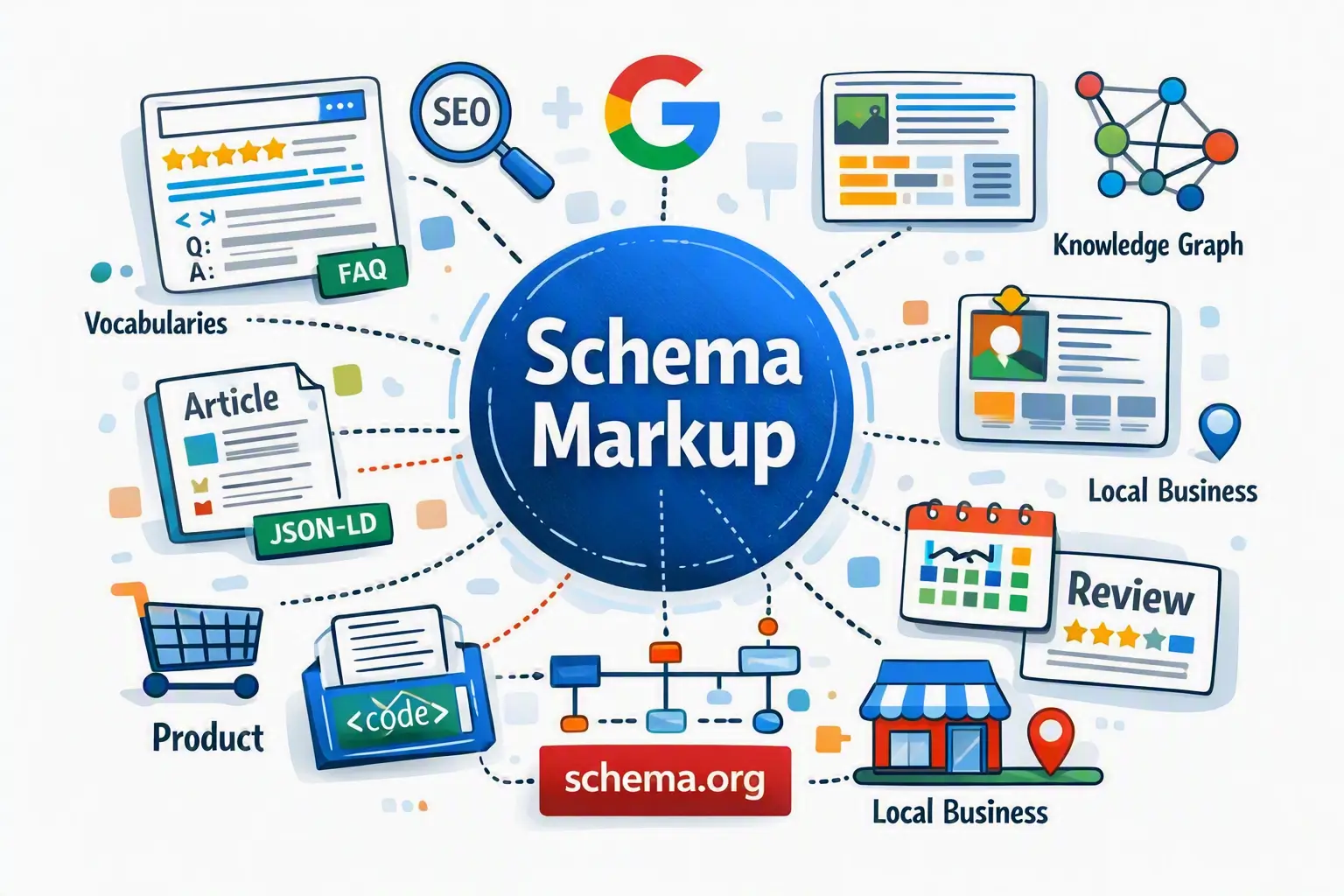
When Google said “you don’t need schema for AI Search,” a lot of people took it as a funeral notice for structured data. Especially me, because I’ve been singing Schema’s praises for years now.
But that’s not what it means at all. As a web designer who spends half my life inside WordPress dashboards and SEO plugins, I see schema as the quiet translator between your site and Google’s (better) understanding of it. It’s not a magic key to AI visibility. It’s a framework that helps Google recognise what your page is about and decide whether it qualifies for rich results. In other words, schema markup still plays a crucial role in how your content is interpreted, even if it’s not the golden ticket into AI Overviews.
1. Which Google Search features actually rely on Schema?
Quite a few, but there’s an important distinction between “uses structured data” and “requires structured data.”
Google currently lists these structured-data-supported Search features:
| Search feature | Structured data relevant? | Why it matters |
|---|---|---|
| Article | Yes | Can help Google understand articles and enable supported richer appearances |
| Breadcrumb | Yes | Helps represent site hierarchy in Search |
| Carousel | Yes | Structured-data-driven carousel experiences; some are currently beta |
| Course list | Yes | Education/course information |
| Dataset | Limited/currently changing | Google says Dataset structured data is now only used by Dataset Search, not general Google Search |
| Discussion forum | Yes | Helps identify forum content |
| Education Q&A | Yes | Supports education Q&A search experiences |
| Employer aggregate rating | Yes | Employer information/ratings |
| Event | Yes | Event information |
| Image metadata | Yes | Helps Google understand image information |
| Job posting | Yes | Job details in Google’s job-search experience |
| Local business | Yes | Business details such as hours, ratings and actions |
| Math solver | Yes | Supports mathematical problem/solution experiences |
| Movie | Yes | Movie carousel information |
| Organization | Yes | Organisation identity, logo and related information |
| Product | Very important for WooCommerce | Product snippets, merchant listings, variants and related shopping information |
| Profile page | Yes | People/organization profile information |
| Q&A | Yes | Q&A search features |
| Recipe | Yes | Recipe rich results/carousels |
| Review snippet | Yes | Review/rating information for supported entities |
| Software app | Yes | App information and ratings |
| Speakable | Yes | Identifies content suitable for text-to-speech in supported contexts |
This is Google’s current structured-data feature list.
For the sort of websites I work on, I pay particular attention to five
1. LocalBusiness
Particularly relevant to local SEO. It can communicate business information such as opening hours, location and other business details. (Reference)
2. Organisation
Useful for establishing the identity of the organisation, including its name, logo, contact information and identifiers.
3. Product
This is particularly important for WooCommerce. Product structured data can communicate things such as price, availability and reviews, and Google supports product snippets and merchant listings.
4. Article
Relevant to the blog/content strategy we’re discussing here.
5. Breadcrumb
Still useful for communicating hierarchy and potentially improving the way pages are represented in Search.
And there’s a new-ish one worth watching: structured-data carousels. Google currently has a beta carousel experience using ItemList with supported types including LocalBusiness, Product and Event.
So what is Google’s actual position?
I’d interpret it like this:
Schema can help Google understand what a page is and can make it eligible for certain Search features. It isn’t a special signalling mechanism for getting into AI Overviews or AI Mode.
That’s almost exactly the nuance Google’s new AI guidance establishes. Google says structured data isn’t required for generative AI Search and that there is no special Schema.org markup required for it, but recommends continuing to use structured data as part of your overall SEO strategy because it can help with eligibility for rich results.
And it was exactly the websites using markup data that showed up first in AI citations a while ago.
One other important point: eligibility doesn’t guarantee appearance. Google explicitly warns that even correctly implemented structured data doesn’t guarantee that a rich result will actually be shown.
So I wouldn’t remove schema from a properly built WooCommerce or local business website. I’d just stop selling it to clients as “AI optimisation.”
From what I’ve seen across client sites, the content that consistently shows up in AI citations is the one that answers a real question clearly and honestly. Unique, human‑written explanations that get straight to the point seem to resonate most with Google’s AI systems.
In a way, it’s proof that genuine expertise and relevance still beat algorithmic shortcuts. Schema helps Google understand your content, but it’s the clarity and authenticity of your message that make it worth citing.
Takeaway
Schema markup and content quality aren’t competing priorities; they’re complementary. Schema gives Google the structured signals it needs to interpret your site and decide whether it qualifies for rich results. But it’s the clarity, honesty, and usefulness of your content that makes it worth surfacing in AI citations or answers.
In practice, the winning formula is simple: use schema to make your content eligible, and write with authenticity to make it valuable. Together, they form a balanced SEO strategy that works across both traditional search and the new AI‑driven landscape.