DIGI-DEFCON 6: What “Black October 2026” Means for Ordinary People
For years, cybersecurity incidents were something that happened to “other people”. A company gets hacked. A database leaks. A software vendor scrambles to release a patch. The average person barely notices.
October 2026 felt different.
A series of significant security events landed almost on top of one another. Critical vulnerabilities, supply chain compromises, certificate trust issues, and emergency security updates across widely used technologies all contributed to what some security professionals have started calling “Black October”.
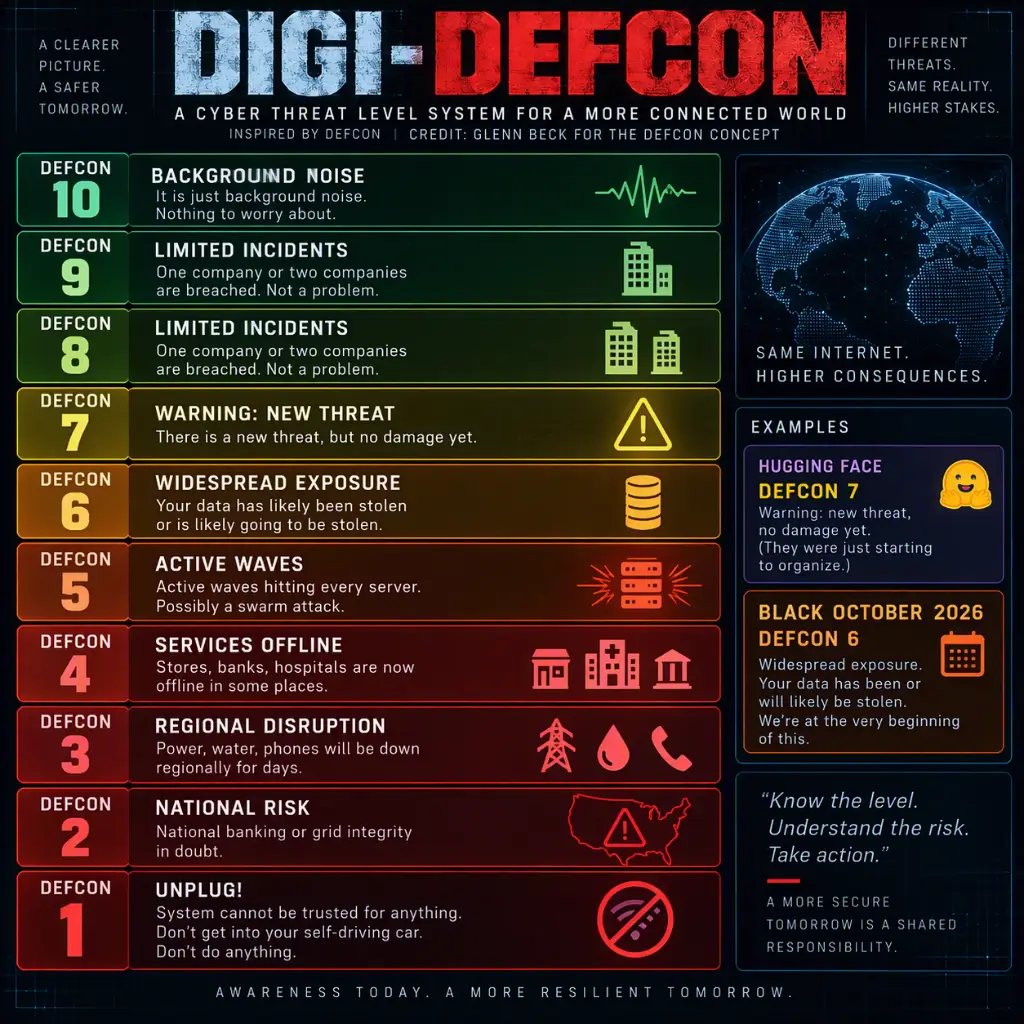
Using the DIGI-DEFCON scale, this situation sits at DEFCON 6: Widespread Exposure.
That does not mean civilisation is collapsing. It does mean many people should assume that at least some of their personal data has already been exposed or is at increased risk of exposure.
First, Don’t Panic
Let’s be clear about what DEFCON 6 means.
It does not mean:
- The internet is shutting down.
- Banks are failing.
- The power grid is collapsing.
- You should disconnect all your devices.
Those situations belong much lower on the scale.
DEFCON 6 means:
The attack surface is growing faster than organisations can completely defend it.
In plain English, hackers are finding more doors, windows, and weak spots than security teams can realistically patch overnight.
Why Black October Matters
Several unrelated but significant incidents appeared during the same period:
- Critical PHP vulnerabilities affecting technologies used by millions of websites.
- PHP2Shell-related exploitation concerns.
- The LiteLLM supply chain incident.
- Compromised intermediate certificate authority keys at eMudhra.
- Security advisories and patches from major software projects including Node.js and GitLab.
- Growing evidence that AI tools are helping both defenders and attackers discover vulnerabilities faster.
None of these events alone necessarily represents a global crisis.
Together, however, they reveal a trend:
The cybersecurity ecosystem is becoming more complex, more interconnected, and more difficult to secure.
The AI Factor Changes Everything
The most important long-term story may not be any single vulnerability.
It may be artificial intelligence.
Traditionally, finding software weaknesses required highly skilled researchers working slowly and methodically.
Today, AI-assisted analysis can help identify:
- Coding mistakes
- Security misconfigurations
- Hidden attack paths
- Weak authentication methods
- Potential exploit chains
The good news is that defenders can use these tools.
The bad news is that attackers can too.
AI does not choose a side.
It accelerates whoever is using it.
What Does This Mean for You?
Most people hear about cybersecurity incidents and ask:
“Should I be worried?”
The honest answer is:
You should be alert, not afraid.
The average citizen is unlikely to be directly targeted by sophisticated nation-state attacks.
However, ordinary people are often affected indirectly when organisations experience security failures.
Possible impacts include:
More Password Breaches
If websites are compromised, user credentials may eventually appear on criminal marketplaces.
This is one reason security experts strongly recommend:
- Unique passwords for every account
- Password managers
- Multi-factor authentication (MFA)
Increased Phishing Attacks
Criminals often use leaked information to make scams more convincing.
Future phishing messages may include:
- Your real name
- Previous addresses
- Employer details
- Accurate account information
This makes fraudulent emails harder to spot.
Identity Theft Risks
The more data exposed across different breaches, the easier it becomes for criminals to assemble complete identity profiles.
Individual leaks may seem harmless.
Combined together, they become powerful.
Service Interruptions
Even when data is safe, widespread patching and incident response can cause temporary outages.
You may notice:
- Online services unavailable
- Banking delays
- Login issues
- Website downtime
Most of these disruptions are temporary.
Where Could This Go in the Next Two Months?
Any prediction should be treated as informed analysis rather than certainty.
High Confidence
We will likely see:
- More emergency software patches.
- More security advisories.
- More organisations discovering previously undetected compromises.
- Increased pressure on companies to accelerate patch management.
This is normal after major vulnerability disclosures.
Medium Confidence
We may see:
- Additional incidents linked to vulnerabilities discovered during Black October.
- New exploit attempts against organisations slow to update systems.
- Increased regulatory scrutiny and reporting requirements.
Attackers are known to move quickly once vulnerabilities become public.
Low Confidence
There is currently insufficient evidence to predict:
- Large-scale infrastructure failures.
- National grid disruptions.
- Banking system collapse.
- Internet-wide outages.
Those outcomes belong much lower on the DIGI-DEFCON scale and would require far broader and more coordinated damage than has been publicly demonstrated.
So Are We Headed Toward DEFCON 5?
Possibly, but not necessarily.
A move from DEFCON 6 to DEFCON 5 would require evidence of large-scale, active attack waves affecting vast numbers of systems simultaneously.
That threshold is higher than simply discovering vulnerabilities.
Many severe security incidents never progress beyond widespread exposure because organisations patch quickly, improve monitoring, and contain threats before they spread.
In other words:
A vulnerability is not the same thing as a catastrophe.
What Should People Do Right Now?
If Black October teaches us anything, it is that cybersecurity is no longer just an IT department problem.
Every individual should:
- Enable multi-factor authentication wherever possible.
- Use a password manager.
- Change reused passwords immediately.
- Install updates promptly.
- Be sceptical of unexpected emails, texts, and phone calls.
- Keep backups of important files.
- Monitor financial accounts regularly.
These simple actions protect against the overwhelming majority of attacks affecting ordinary citizens.
Final Thought
The purpose of the DIGI-DEFCON chart is not to create fear. It is to create awareness.
Black October 2026 appears to be a DEFCON 6 event because it highlights a troubling reality: the internet has become deeply dependent on a small number of critical technologies, and weaknesses in those technologies can have global consequences.
The good news is that we are still in a stage where prevention, patching, and vigilance matter enormously.
The systems may be under pressure, but they are not yet beyond trust.
The challenge for the next two months will be simple to describe, but difficult to achieve:
Can defenders patch vulnerabilities faster than attackers can exploit them?
That answer will determine whether Black October becomes a historical footnote, or the opening chapter of something much larger.