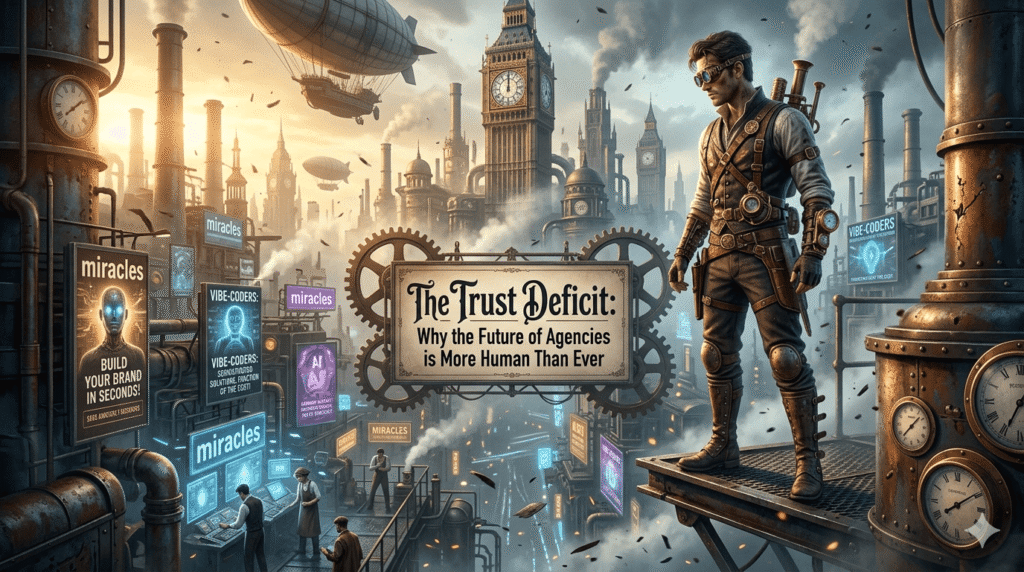
The digital landscape is currently saturated with “miracles.” Business owners are bombarded with adverts for AI tools that promise to build entire brands in seconds and “vibe-coders” offering sophisticated solutions for a fraction of traditional costs. It’s a gold rush of efficiency, but it’s creating a massive, invisible problem: the erosion of support.
When a business owner buys into a “created in mere seconds” AI solution or a fly-by-night coder, they aren’t just buying a website; they are buying a liability. The moment they need an update, a custom integration, or a fix for a broken script, the “vibe-coder” is gone, and the AI offers no empathy. When they eventually knock on the door of a professional agency and hear that fixing a non-mainstream, automated mess will cost R9000+, the “meltdown” begins. They’ve been conditioned to believe that digital assets are cheap and instant.
However, this disruption is exactly where the modern agency finds its greatest opportunity for differentiation.
The Myth of Automation vs. The Value of Guidance
While AI can generate a layout or a blog post in an instant, it cannot provide strategic guidance. Agencies are evolving from “builders” into “guides.” A significant portion of the market still hasn’t fully embraced AI, and those who have are often drowning in its complexities.
Our role is no longer just “IT support”; it is about being the human on the other side of the screen who ensures that the output is scalable, professional, and aligned with a real business goal. WordPress remains a vital asset here because it offers a stable, mainstream foundation – unlike the experimental, fragmented “vibe-coded” solutions that leave clients stranded.
Trust as the Premium Currency
In a market where bots can undercut any price, trust becomes the only sustainable competitive advantage. Customers are faced with a choice: a low-price AI bot or a premium, 100% organic human connection. Increasingly, the preference is shifting back to the organic.
Why? Because human relationships aren’t obsolete. Just as the internet didn’t kill books, AI won’t kill the need for a consultant you can look in the eye. People don’t want to be “processed” as a transaction; they want to feel supported. Agencies should lean into this: be transparent about using AI, show how it streamlines your workflow, but emphasise that the human is the one steering the ship.
AI as a Collaborative Tool, Not a Replacement
AI is at its best when it acts as a bridge. For those who find video production daunting or writing tedious, AI can translate spoken ideas into polished scripts while maintaining an authentic human voice. It can extract value from massive datasets to find the “nuggets” of truth in human conversations.
The agency of 2026 isn’t one that competes with AI, but one that uses AI to amplify its humanity. We use the tech to do the heavy lifting, so we have more time to build the connection, the strategy, and the trust that a machine simply cannot manufacture.
History shows that technology rarely “replaces” human needs; it only shifts them. When photography was invented, people thought painting was dead – instead, painting became more expressive and “fine art” was born.
AI is currently in its “Wild West” phase. The “meltdowns” that clients are having over R9000 rebuilds are a symptom of a market that hasn’t yet learned that cheap tech is often the most expensive thing you can buy. The role as an agency or freelancer is to remain the “Adult in the Room.”
My opinion? The “vibe-coder” era will burn itself out quickly because businesses cannot survive on tools that have no “after-sales” support. By doubling down on Scalable Human Support, you aren’t being old-fashioned – you are being future-proof. You are selling the one thing AI can’t hallucinate: Responsibility.